Research

Every step of the research, and what it became here.

Cognitive Inhabitation is built as an academic instrument first. Each stage below is paired with the part of this platform it turned into — and marked with what it is: published, in preparation, or run once and awaiting a controlled re-run.

01Paper 1

A building's social life can be read from the drawing, before it is built.

Cognitive Inhabitation Analysis: Demonstrating Cognitive-Agent Simulation in BIM-Based Architectural Space
Minjun Song · Younghoon Jeon · 36 inhabitants · 3 days × 3 independent seeds · submitted to the AIK 2026 Autumn Conference
The research

The founding study. Five patterns from one building: how a home base forms, how a group's clustering splits into spatial causes (encounter), how one room gets appropriated for several uses, how a topic crosses a boundary (diffusion), and how behaviour shifts from day to day (adaptation).

In our platform today

Every M1 replay on the Evidence page is raw output from this run — nothing edited, nothing staged. The abstract and the three-seed research data are open on the paper page. Paper page & data → · See the replays →
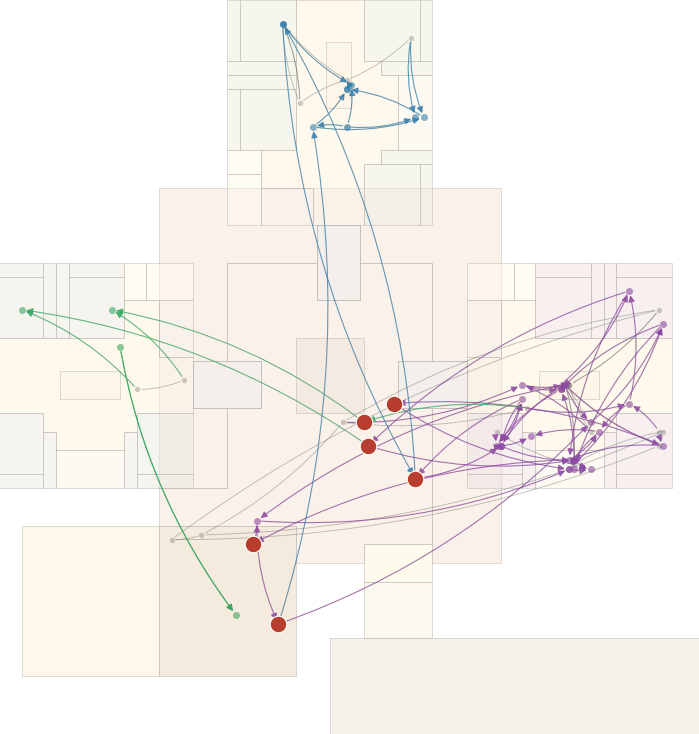
How a topic spreads across groups, day 2
Fig. 01 — How a topic spreads

Day 2 of a three-day run. Each arrow is one person moving between talks about the same topic, coloured by group; a red dot marks where two groups met and it crossed over.
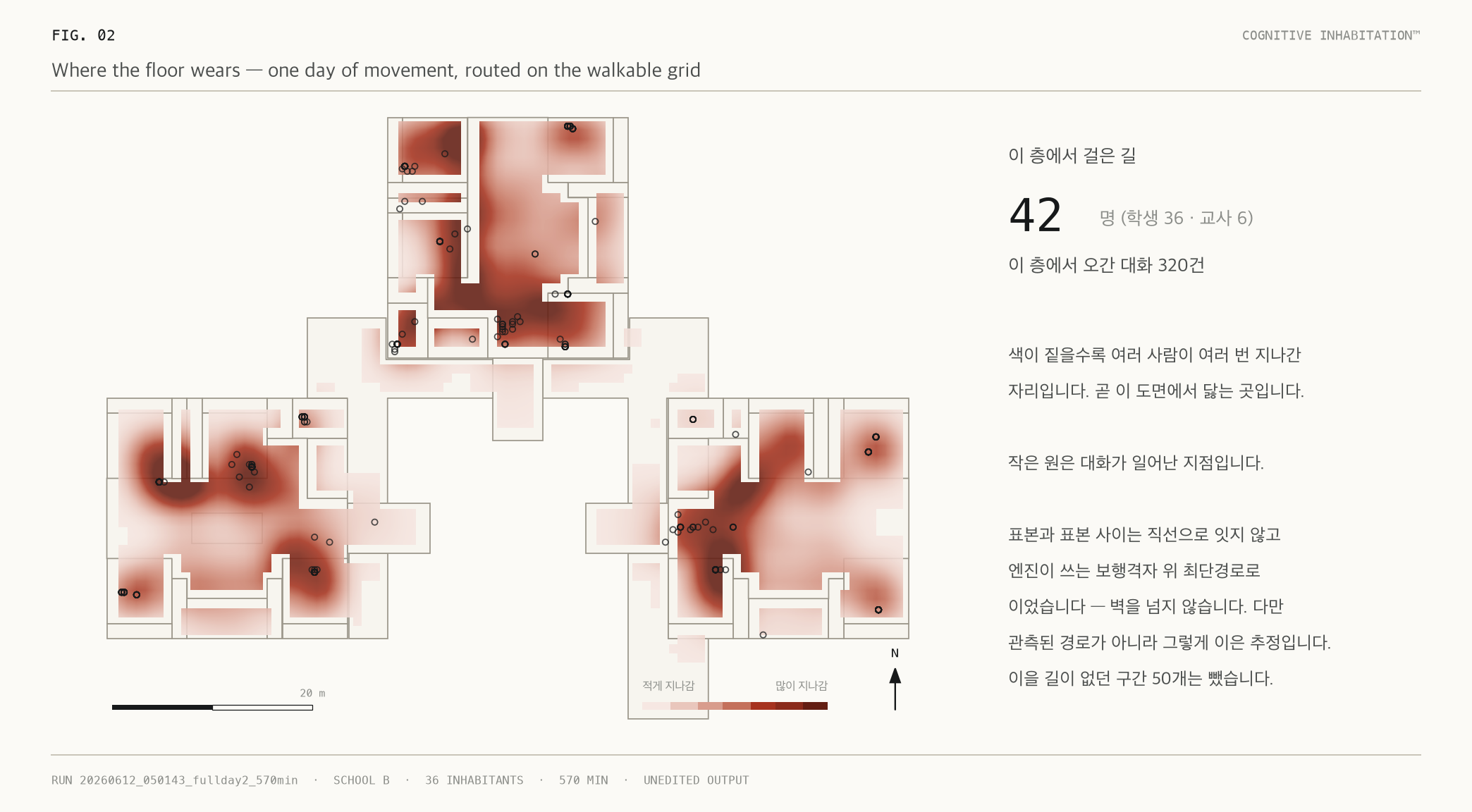
Density of one day of movement over the classroom floor, with conversation points
Fig. 02 — Where the floor wears

One day on the classroom floor. The darker the shading, the more people passed there more often — the routes this plan actually wears in. Between samples the path is routed on the walkable grid, so no line crosses a wall; it is an inferred route, not an observed one.
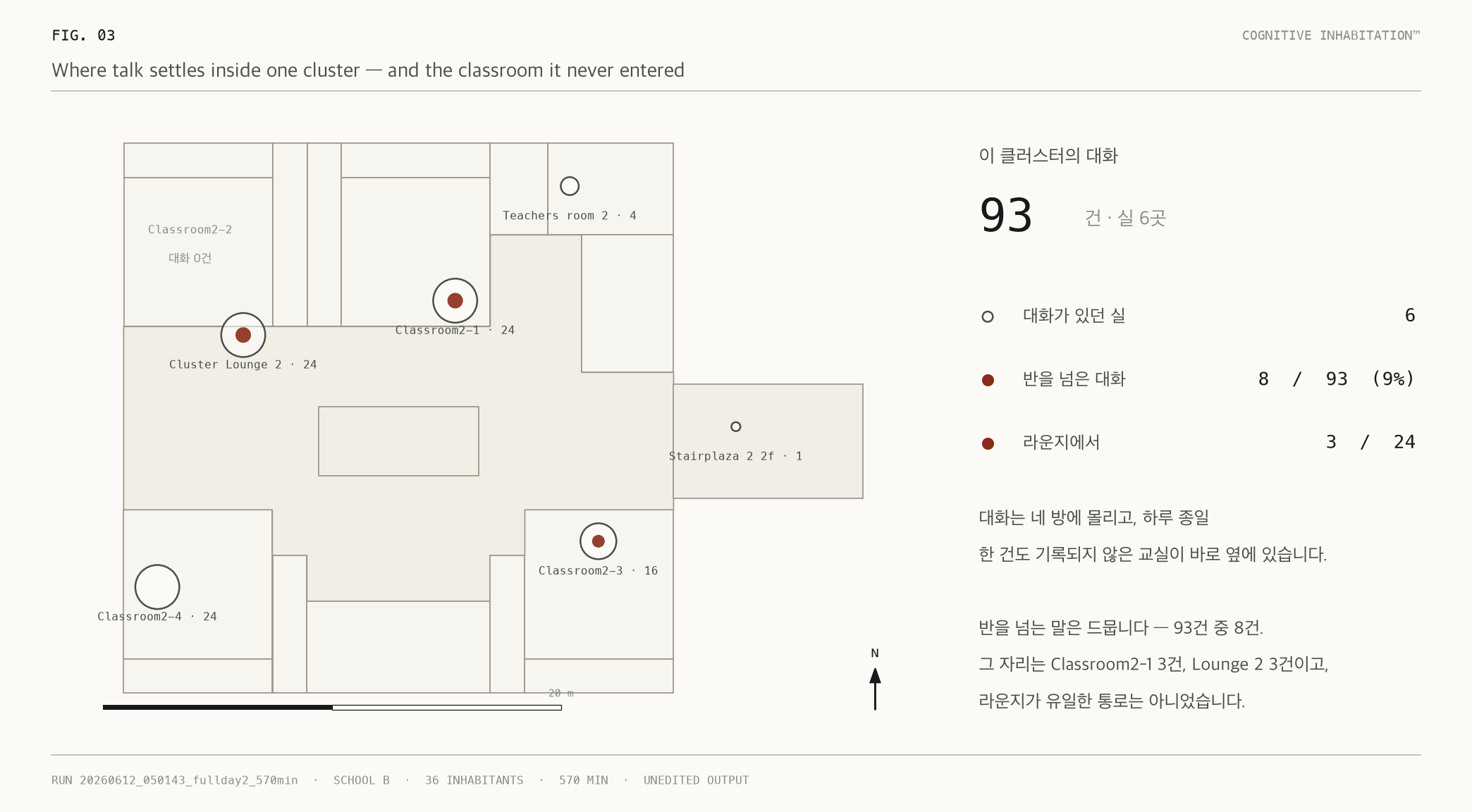
Conversations per room inside one cluster, with the classroom that recorded none
Fig. 03 — Where talk settles, and where it never arrives

One cluster of the upper floor. Circle area is the number of conversations recorded in that room; the brick core is the share that crossed a class. Ninety-three conversations gathered in four rooms — and one classroom recorded none at all.

02In preparation

We took the grid away, and people started moving along what they could see.

Tile grid versus continuous space: does the way we represent a floor change what we read from behaviour?
Technical report in preparation · to be developed into a paper
The research

The first generation moved cell by cell on a tile grid. The second treats the floor as one continuous surface and lets an open sightline, not a cell wall, decide the route. The same drawing then produces different paths — and the question this report asks is whether that difference changes the reading, or only the picture.

In our platform today

The Yeosu replay already runs on the continuous-space engine; the M1 replays beside it are the original tile runs. Both are on this site, so the difference can be watched rather than argued. Yeosu replay →

tile grid continuous space
Schematic, not measured data — the same origin and destination, read by the two generations of the engine.
03Report complete

A place stopped being an address and became something an agent remembers.

Spatial Cognition Architecture: perceiving a place, and forming an impression of it
Internal report complete · being written up as a paper
The research

Instead of being handed a coordinate, an agent perceives what a place is like, remembers what happened there, and builds up an impression of it. An impression is only allowed to exist if it can cite an event the agent actually lived through — that rule is what keeps the reading honest.

In our platform today

This is where the softer readings come from — which rooms people return to, where they linger, and which rooms are never chosen at all. More on Method →

04First pass run

Same inhabitants, different architecture — so the difference has only one place to come from.

Corridor versus cluster: a controlled comparison of two plans for the same brief
Paper 2 · first pass run on the first-generation engine · controlled re-run on the current engine pending
The research

The same thirty-six people live in a corridor-type plan and in a cluster-type one. Because the inhabitants are held constant, every behavioural difference is attributable to the architecture and to nothing else.

In our platform today

The A/B footage on the home page and the Sandbox board come from the first pass of this experiment, run on the first-generation engine — that is where the ×11.5 figure comes from. What is still pending is the controlled re-run on the current engine, which is what the paper will report. A/B comparison →

Open question

The question we have not answered yet: how close is a reading to a building people already live in?

Calibration against an occupied building · survey-informed inhabitants
The research

Simulate a building that is already in use and hold the result against how it is actually used. Then put what people say they prefer next to how they are seen to behave. We are not putting a date on this, and we would rather say so than announce one.

In our platform today

Nothing yet. Until it is done, we describe what the instrument reads — not what a building will do.

Record

Papers and reports as they are completed, in order. Summaries are public; full reports are sent on request.

  1. 2026.10
    Cognitive Inhabitation Analysis: Demonstrating Cognitive-Agent Simulation in BIM-Based Architectural Space
    Architectural Institute of Korea, 2026 Autumn Conference · general session · 4 pages · submitted 16 Sept 2026. Abstract and three-seed research data on the paper page.
  2. 2026.06
    Cognitive Inhabitation Report — School, comparative analysis of schemes A and B
    Two schemes, same inhabitants, one day. The first report written on this instrument.
  3. 2026.09
    Cognitive Inhabitation Report — AI studio at an elementary school, comparative analysis of alternatives
    Renovation of classrooms into a shared AI lounge. Delivered to the school and the education office.
    completed
  4. 2026.10
    Cognitive Inhabitation Report — a city community service centre, comparative analysis of alternatives (pre-planning commission)
    A public building whose problems are behavioural: queues, waiting, privacy at the counter, rooms that stay empty.
    in progress